Key Insight 2
Applying Statistical Knowledge in Research
During the fall semester of my senior year, I was enrolled in PSYC 221: Research Methods in Psychology. This class was my final psychology research methods course. One of the main objectives of this class was to design a research study from start to finish. Which included developing a hypothesis, searching a database, making meaningful measurements, and organizing and interpreting data for the use of our research paper. What I remembered the most about this class from the start was that it was very fast paced and because of the pace I couldn’t sit and think of a topic that might interest me. Then it hit me. My friends and I are a very diverse group when it come to our majors. I have some friends who are business majors, some are engineering majors, and some are hospitality majors. We always joke to each other about which major is harder and which major is easier. Usually, my non-STEM friends are free to go to sporting events and are more readily available to eat and hang out, because of this I noticed that my friends who are STEM majors had less time to hang out and seemed more “depressed” in some sense whenever we would all hang out together.
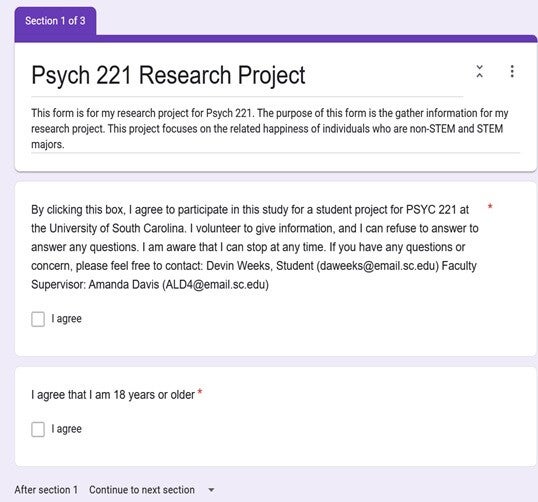
This allowed me to do my research paper on a topic I was truly interested in and would be my first research paper in which I completed. Before this class I have never done a research paper that included incremental parts of a research paper such as the abstract, results, methods, and discussion of limitations sections. When drawing up this study I wanted to know if there was a relationship between happiness and perceived course difficulty amongst STEM and non-STEM majors. Obtaining the data for this research study, I had to make a survey and go beyond the classroom to get the responses I needed for my study. I had a mean of 30 participants. The responses from the survey were then transferred over to an excel sheet which allowed me to export into SPSS (statistics application) to calculate the correlation of happiness amongst STEM and non-STEM majors. The artifact below is my beyond the classroom experience and completed research paper.
I had never created a survey before, so this was a first for me. This was a study my friends and I were very interested in so I sent them the link to the google forum. Once my friends completed the forum I had to go out and find people who were willing to complete the survey for me until I reached 30 participants. The creation of the survey helped me grow personally because I understood the importance of informed consent and various ethical research practices, reading and understanding data, and was able to do community research in a field that is closely tied with clinical psychology. My study found that the level of happiness someone endures does not reflect the major they picked. My study also found that the perceived course difficulty of majoring in STEM seemed to be harder than majoring in something that is non-STEM.
This artifact shows the consent page of my survey, used to collect data for my research paper. Having consent is the upmost of importance when collecting data from human participants.
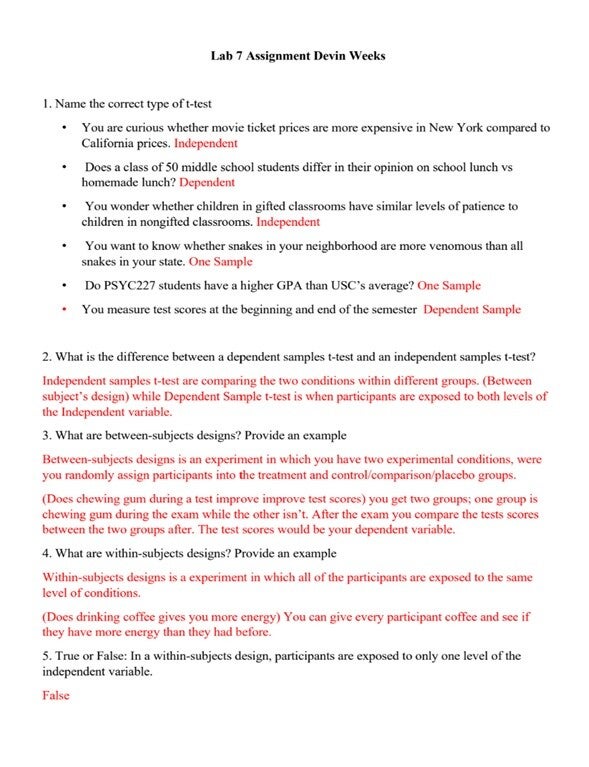
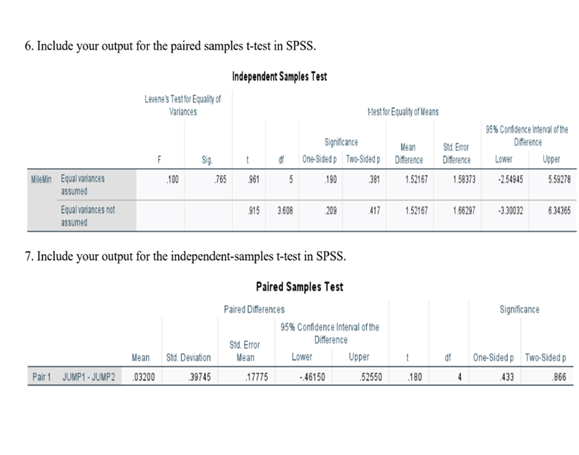
A class that played a crucial role in my understanding of statistics that helped me with this project was PSYC 220: Psychological Statistics. This class was one of my favorite classes at USC. The purpose of this class was to compute and interpret statistics. During this class I had weekly homework assignments in which I preformed basic data management and statistical techniques using a statistical software program (SPSS as mentioned earlier) in class. These weekly homework assignments helped me understand and apply the basic concepts of statistics and by doing so I was able to run multiple tests including independent samples and paired samples test. We learned to differentiate the many tests psychologist use to preform statistical analysis by using random examples for homework. Completing the homework assignments that were based on SPSS prepared me for my ability to perform tests in PSYC 221. The artifact below is a within the classroom experience from PSYC 220.
Create Your Own Website With Webador